
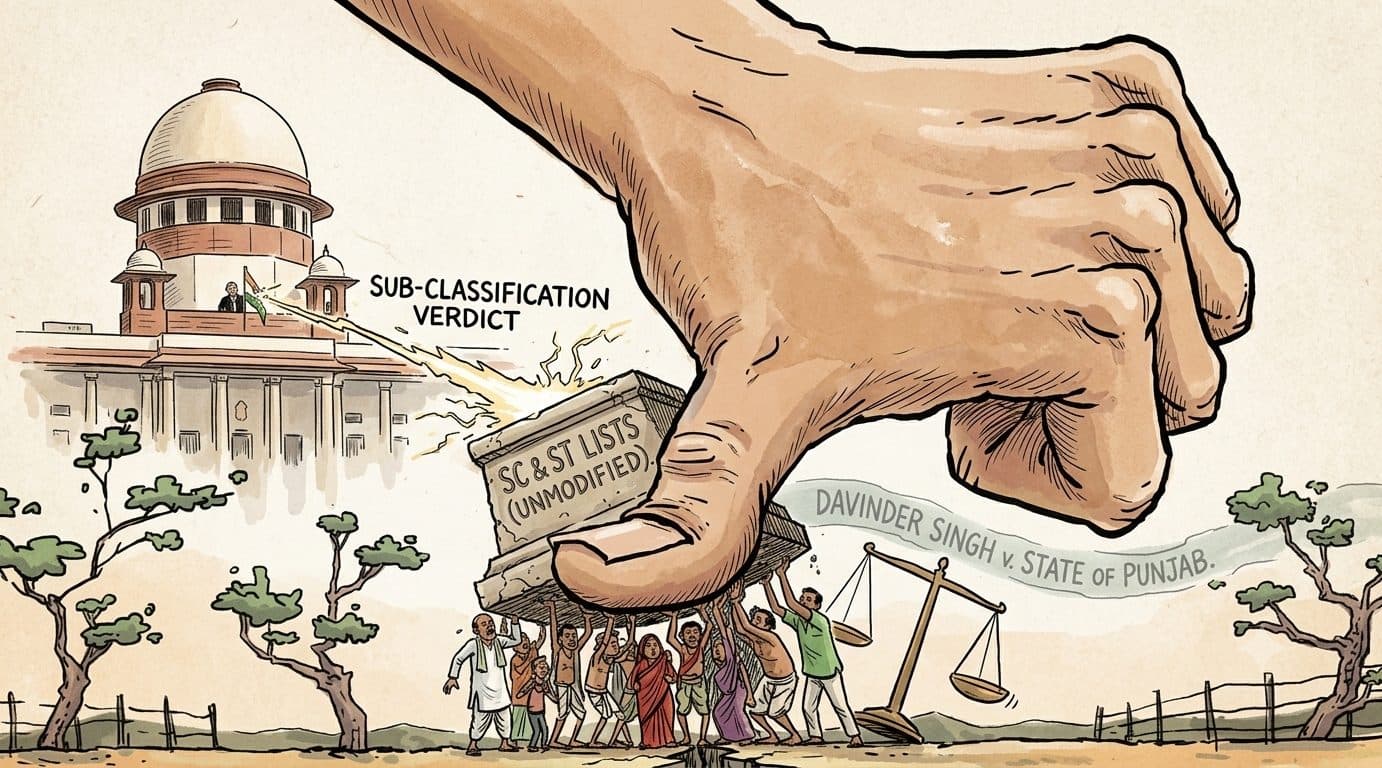
The present case comment is co-authored by Mr. Vedant Nandkumar Wadshingkar and Mr. Utkarsh Nivrutti Patil, final-year students at Government Law College, Mumbai.
Introduction:
The dawn of 5th September turned a new leaf in reservation jurisprudence, with the Supreme Court upholding the sub-classification within the Scheduled Castes & scheduled tribes (hereinafter SC & ST, respectively). For the champions of merit, this verdict is a death knell for the tactics of unjust enrichment that plagued the reservation policy for a long. For some pro-reservation lobby groups, the verdict is equivalent to a divide-and-rule policy. Because the proclivity of this action to unsettle Indian politics is manifold, the authors believe a thorough & unbiased analysis of the judgment is warranted.
The journey of reservation jurisprudence is so perplexing that many of the earlier judgments have turned into a mere relic of the past by legislative as well as judicial actions. Whether these judgments overturned by constitutional amendments were the candid expression of social justice or were done under political compulsion isn’t the question this essay endeavours to answer. The lynchpin of this essay revolves around the judicial non-compliance with the doctrine of stare decisis for substantive equality & social justice. This judgment has uniquely built upon those legions of judgments wherein the court has advanced a more expansive interpretation of equality & social justice in reservation jurisprudence.
Factual Underpinnings: The Building Blocks?
Articles 15 & 16 of the Constitution empower the state to take affirmative action for the benefit of ST, SC & other backward classes[1]. Indian politics is replete with instances wherein states have exercised this authority in the pursuit of social justice. Punjab Government in 2006 did the same by enacting the Punjab Scheduled Castes & Backward Classes (Reservation in Services) Act[2]. Section 4(2) of the Act reserved 25% of seats for Scheduled Castes[3], while Section 4(5) withheld 50% of the seats reserved for the scheduled castes for Balmikis & Mazhabi Sikhs[4]. Punjab & Haryana High Court declared Section 4(5) unconstitutional in the year 2010. Raison d’etre of this decision largely hinged on E.V. Chinnaiah vs State of Andhra Pradesh (hereinafter Chinnaiah)[5]. The state’s appeal against the High Court’s decision nudged the three-judge bench of the Supreme Court to refer the same to the larger bench in the year 2014. Constitutional Bench in the year 2020 accentuated the compelling need to revisit the Chinnaiah judgment by the seven-judge bench[6].
Arguments Advanced: War of Words?
If we want to pluck one commonality in the arguments of both sides, undoubtedly it is the Chinnaiah judgment. For petitioners, the judgment was irrelevant at best & erroneous at its worst, while for respondents, it assumed the importance of sanctum sanctorum in sub-classification doctrine. Petitioners considered sub-classification as the modus operandi for realising substantive justice, whereas the perpetuation of exclusionary effect formed the fulcrum of respondents' arguments. The identity of ST & SC was assessed through the binoculars of homogeneity & heterogeneity by respondents & petitioners respectively. Petitioners relied on entry 41 of List II.[7] & entry 25 of List III of the 7th Schedule to justify the legislative competence of the state to make preferences[8]. On the contrary, respondents availed benefits accruing from the strict interpretation of Article 341 to invalidate the state legislature's competency in the sub-classification matters[9].
Based on these deliberations, the court's task was set to adjudicate upon the catena of issues on sub-classification. The court not only had to examine the constitutionality of sub-classification within SC & ST but also had to investigate the homogeneity or heterogeneity of the class. The controversy did not end here, as the court had to determine the permissible threshold of classification if sub-classification per se withstands the norms of constitutionality[10].
Chinnaiah Judgment: Too Old to Be Relevant?
Uncanny resemblances with the factual parameters somehow elevated the status of Chinnaiah's judgment from being a mere case law to the cynosure of the deliberations. Just put Andhra Pradesh in place of Punjab & replace the Punjab legislature of 2006 with the Andhra Pradesh Scheduled Caste Act, 2000 & you are halfway down in the facts[11]. No doubt the allocation formula as well as the castes enumerated in these acts differed, but these were mere nomenclatural differences without any difference in the spirit.
The court not only struck down the law but also laid the foundation of the superstructure whose reverberations were felt all across the spectrum. Not only did the court consider such an act tantamount to tinkering with the presidential list notified under Article 341, but it also identified SC & ST as a homogeneous class by virtue of deeming fiction. The legislative prerogative of the state to sub-classify was denied & observations were made that the efficiency of administration under Article 335[12] would be diluted if such legislative action gets a green signal.[13] The ratio decidendi of this judgment was so pertinent that the Supreme Court felt the impending need to debunk the judgment.
Encumbered Efficiency: Blot on Sub-classification?
One of the arguments against the sub-classification was its pernicious effect on the efficiency of administration. Article 335 of the Constitution spells out the provisions relating to the efficiency of administration, as per which due consideration should be given while deciding the claims of ST & SC in the appointment of services[14]. It was the Rangachari case, wherein the aspect of efficiency regarding reservations in promotions was discussed 1st [15]. The said judgment was overturned in Indira Sawhney[16] wherein the court proclaimed that such kind of reservation may dilute the efficiency of administration. However, this value judgment was rendered redundant by the 77th Constitutional Amendment Act[17]. The judgments of Vinod Kumar vs. U.O.I[18] as well as T. Dewadasan vs U.O.I[19] met the same fate as the 82nd [20]& the 81st constitutional amendments provided constitutional patronage to the policy relaxation in qualifying marks as well as the carry-forward rule[21].
Court, along with this rich historical tapestry, also inspected the nexus between Article 335 & Article 16[22]. The court held that unlike Article 15[23], the gamut of Article 16 is much wider & generalized, as the nomenclature used is the backward class, which cannot be confined to certain specific categories. The court even clarified that merit at best, can only be one of the aspects of efficiency & cannot be the only equivalent of efficiency. While reading the provisos of Article 335 court reiterated that inefficiency would creep in only when there is total removal of marks & not when there is relaxation in qualifying marks[24]. The court emphasised decisions in B.K. Pavitra vs Karnataka[25] as well as Neil Aurelio Nunes Vs. U.O.I.[26] to discard the notion that high marks mean high efficiency. The bench, on the one hand denied that Article 335 can in any manner proscribe the exercise of authority under Articles 16(1) & 16(4), while on the other hand accentuated the need for a wider interpretation of merit in terms of the social good of equality & inclusivity. Neil Aurelio Nunes Vs. U.O.I.
Micro-classification: Onslaught on Constitutional Ethos?
In Chinnaiah's judgment, the bench bestowed the status of a homogeneous class on the ST/SC & held that further classification within the class would frustrate the doctrine of reasonableness. Such micro-classification & the plausible transgression of Article 14 compelled the court to clarify at the outset that equality before the law does not entail sameness[27]. The court explained that the classification that fulfils the 2-pronged criteria of intelligible differentia & rational nexus would be reasonable & will not vitiate the equality envisaged under Article 14[28]. In a nutshell, if the classification has attained validity in the presence of a particular rationale, then in the presence of the same rationale, the sub-classification will be legitimate also. Recourse was sought in a plethora of cases, precisely Triloki Nath Khosa vs State of Jammu & Kashmir[29] & D. S. Nakar vs. U.O. I[30], to demonstrate the essential conditions of constitutionally valid sub-classification. To summarise, the court held that when the class is homogeneous, sub-classification doesn’t stand a chance. Only when it is proved that the members of the class aren’t similarly situated, sub-classification will be permitted if the 2-pronged test of reasonableness is extant. This court's opinion nonetheless comes with the rider that any interpretation of this judgment that justifies minute & microcosmic classification would make the voyage toward substantive equality arduous.
Article 341: Deeming Fiction?
Article 366(24) [31] in simple words defines ST as those castes, races, tribes that are deemed SC under Article 341[32]. Article 341 represents the procedural aspect of this section by which the President is empowered to notify the castes, races, tribes that can be included in the list. Article 366(25) & Article 342[33] of the Constitution exactly replicates the same for ST. The word deemed in these articles creates a lacuna as to whether the provision has the charter deeming fiction or not. Deeming fiction, in layman's language, means that certain facts shall be presumed to exist despite the material absence of the same. The court laid stress on the Bengal Immunity Company Ltd. v. Bihar to underline that the creation of deeming fiction is restricted to only legitimate fields.[34]. Recourse was taken to the East End Dwelling Company Limited case to highlight that the scope of legal fiction needs to expand to understand the consequences that emanate from legal fiction.[35]. The court opined that the usage of the word deemed only conveys that the notified castes or groups of castes shall be considered SC/ST & nothing else. Thus, the contention that Article 341 read with Article 366(24) engenders a deeming fiction was not considered by the court due to the conspicuous absence of any artificial construction in support.
Scheduled Caste: Tussle between Homogeneity & Heterogeneity
The doctrine of sub-classification has trod an arduous path if one contemplates the journey from reservation jurisprudence from Balaji to the Indira Sawhney. Blots of unconstitutionality inflicted in Balaji[36] were wiped out in Vasant Kumar[37], wherein this court opined that sub-classification in backward classes can’t be invalid in the 1st place if ample justifications exist that both backward classes are lagging behind the advanced class & one class within the backward is ahead of the other. It was in Indira Sawhney that these blurred contours were demarcated clearly[38]. While epitomising the court's transition from an advisory tone to an imperative pitch favouring sub-classification, the case also laid down prerequisites of sub-classification like reasonability & substantive distinction. The court scrutinized the veracity of claims asserting the inapplicability of Indra Sawhney through the unique amalgam. The court didn’t stop at theoretical exposition & was cautious enough to investigate ground reality to ensure that the folly of the assumption of deeming fiction doesn’t overshadow the grim picture of society. Whether it is the Hindu census report of 1931[39] or the accounts of A.M. Shah[40], the court left no stone unturned to arrive at an unequivocal opinion on class status. The crux of these sundry annals can be summarised in one sentence: the exterior caste on the higher social plane metes out the same treatment to the other exterior castes which higher castes do towards the exterior castes.
From the hierarchy in the Dalit community[41] to the denial of entrance for lower sub-castes in Dalit temples[42] & from the disparity between the social status of Mala & Maliga castes[43] or the notes of the superintendent on Assam on the backwardness of Mahars [44]every evidence exposed the futility of the contentions espousing the homogeneous status of ST/SC. Due to enriched evidence attributed to inter-se disparity, the court hardly had to encounter any encumbrance to erase the homogeneous identity of ST.
Preferential or Exclusive: The Laxman Rekha for Sub-classification Models
The court not only held the sub-classification constitutionally valid but also laid down the permissible models for sub-classification. The 1st model of preference was fixed on the linchpin that sub-classified groups will first bite the apple. The 1st variation within this model reserved the preference of all the seats for sub-categories whereas the 2nd variation earmarked a certain percentage for the sub-categories. The axis of the 2nd model was fixated on exclusivity, wherein a certain percentage of seats were exclusively withheld for sub-categories in the 1st variation, while the 2nd variation doled out all the seats to the sub-categorised caste, with both variations inherently abiding by the rule of carry forward. The court not only suggested the models but also spoke about their constitutional efficacy. The court believed that the 1st variation of the preference model & the 2nd variation of the exclusive model have weak constitutional compliance vis-à-vis their counterparts.[45]
The Sub-classification Doctrine: Legislative Competency or Predatory Encroachment?
Article 341 has bestowed upon the President only the power to notify, while the domain of exclusion or inclusion has been exclusively reserved for Parliament so that the element of political factor will not mar the list. The contentions were filed with the presumption that sub-classification de facto intrudes into the space to which it doesn’t belong. The court cited the judgments of Bir Singh vs Delhi Jal Board.[46] as well as Chandra Shekar Rao vs Seth GS Medical College[47] to put forward what can be considered as tinkering/meddling with article 341. Any kind of presumption about the nationwide generalisation of caste or the distribution of benefits to those castes that aren’t specified in the list, on the implicit assumption was considered in contrast with Article 341. Despite the myriad intricacies of sub-classification, it was a cakewalk for the court to understand that sub-classification neither involves exclusion nor inclusion, but merely facilitates an affirmative action.
The Watchdog: Scope of Judicial Review?
The nod for legislative competency of the state in sub-classification also brought concerns about the misuse of such prerogative. The court duly recognised the concerns & advanced that this power is subject to judicial review. The requirement of collection of quantifiable data suggesting the inadequacy of representation of sub-categories was accorded the sacrosanct status, in the absence of which such exercise of power can be struck down[48]. It was the effective representation that the court envisaged & not the quantitative one!
Note of dissent: Breach of Procedural Mandate?
Though the dissent notes of Bela Trivedi mentioned Article 341 & Chinnaiah’s judgment, it is the procedural mandate that stole the show. The dissenting judge rightfully pointed out the procedural lapses through the chronological order. Whether it is the absence of any cogent reasons for the referral to the larger bench or the defiance of the doctrine of precedents & stare decisis[49], the dissenting note questioned the very basis of the judgment. From the pernicious impact of such overruling on the law of the land[50] to the unanimous departure of the apex court from earlier judgment[51], each refusal was accompanied by relevant judgments. The importance of the doctrine of precedents & stare decisis was exhorted through the Shah Faisal case[52] wherein it was held that the court ideally should not overrule unless the social, economic & political milieu warrants the same. From the legislative incompetence of the state for sub-classification to the explanation of the deeming fiction, & from deeming fiction to the sui generis interpretation of constitutional ethos, the dissent articulated everything. However, amongst all, it was the foray into the largely eschewed uncharted abyss of procedural lapse that emerged as a cynosure of the dissent note.
New Dawn for Social Justice & Equality: Concluding Remarks
1. The paranoid assumption of impaired administrative efficiency grossly overestimates the role of merit. Sub-classification doesn’t mean the selection of meritless candidates[53]. The preference for the sub-classified less meritorious candidates is not the obliteration, but a relaxation in administrative efficiency!
2. The odyssey of reservation from an exception to equality[54] to the expression of constitutionally sanctified classification[55] negates the argument of supplementary measures if the benefits of reservation are skewed in the backward classes[56]. Formal equality does not transpire into factual equality!
3. Validity of sub-classification derives from inter-se backwardness within the class based on the quantifiable & demonstrable data. If sub-classification lends a helping hand for more backward people within the class to climb the social ladder, then it isn’t advice but an imperative to sub-classify!
4. No doubt the power to alter the presidential list vests in the hands of the parliament, but the preferential treatment of some doesn’t exclude others from the list[57]. Sub-classification isn’t the rechristened name of the creamy layer. It is the creamy layer that excludes, & not the sub-classification!
5. The phobia that sub-classification may result in a deluge of political calculations aimed at clinching ephemeral political gains isn’t wholly unfounded. But with the court's exposition of variations in preferential & exclusive models & the scope of judicial review, the expression of Sentinel on the Qui Vive won't be an exaggeration!
6. No doubt the certainty of law is an essential ingredient of the rule of law, which might lose significance if the court overrules its earlier decisions. However, the rigid acquiescence to the doctrine of precedents & stare decisis, despite metamorphosed social, political & economic conditions, only signals the great sacrifice of equality & social justice!
7. The lapse within the procedural mandate, however, should not be eschewed. The vast treasure trove of substantive justice & equality will turn transient if the procedural mandate is flouted to refer cases to the larger bench without any cogent reason or disagreement!
[1]. The Constitution of India, arts. 15,16.
[2]. Punjab Scheduled Castes & Backward Classes (Reservation in Services) Act,2006 (Act 22 of 2006)
[3]. Punjab Scheduled Castes & Backward Classes (Reservation in Services) Act,2006 (Act 22 of 2006), s.4(2).
[4]. Id., s.4(5).
[5]. E.V. Chinnaiah v. State of A.P. (2005) 1 SCC 394.
[6]. The State of Punjab v. Davinder Singh, AIRONLINE (2020) SC 699.
[7]. The Constitution of India, 7th Schedule, list II, entry 41
[8]. The Constitution of India, 7th Schedule, list III, entry 25.
[9]. The Constitution of India, art. 341.
[10]. Davinder Singh v. State of Punjab, 2024 INSC 562
[11]. Andhra Pradesh Scheduled Castes (Rationalisation of Reservations) Act, 2000 (Act 20 of 2000).
[12]. The Constitution of India, art. 335
[13]. Supra note 5.
[14]. Supra note 12.
[15]. General Manager, Southern Railway v. Rangachari, AIR 1962 SC 36.
[16]. Indra Sawhney v. Union of India (1992) supp (3) SCC 217.
[17]. The Constitution (Seventy-seventh Amendment) Act, 1995.
[18]. S Vinod Kumar v. Union of India (1996) 6 SCC 580.
[19]. T Devadasan v. Union of India (1964) 4 SCR 680.
[20]. The Constitution (Eighty-second Amendment) Act, 2000.
[21]. The Constitution (Eighty-first Amendment) Act, 2000.
[22]. Supra notes 1 & 5.
[23]. Id., art. 15
[24]. M. Nagraj v. U.O.I (2006) 8 SCC 212[108].
[25]. BK Pavitra v. State of Karnataka (2019) 16 SCC 129.
[26]. Neil Aurelio Nunes v. U.O.I. (2022) 4 SCC 1.
[27]. The Constitution of India, art. 14.
[28]. Anwar Ali Sarkar v. the State of West Bengal (1952) 1 SCC 1
[29]. Triloki Nath Khosa v. State of Jammu & Kashmir (1974) 1 SCC 19.
[30]. D.S. Nakar v. U.O.I. (1983) 1 SCC 305.
[31]. The Constitution of India, art. 366(24).
[32]. Id., art. 341.
[33]. The Constitution of India, arts. 366(25), 342.
[34]. Bengal Immunity Company Ltd v. State of Bihar, (1955) SCC OnLine SC 2.
[35]. East End Dwelling Co. Ltd. v. Finsbury Borough Council LR 1952 AC 109.
[36]. Balaji v. State of Mysore AIR 1963 SC 649.
[37]. Vasant Kumar v. State of Karnataka (1985) Supp SCC 714.
[38]. Supra note 16.
[39]. J.H. Hutton “Census of India Report” 471 (1931).
[40]. A.M Shah, “The ‘Dalit’ category and its Differentiation”, Economic and political weekly (2002).
[41]. Ibid.
[42]. Robert F Kennedy, Center for Justice and Human Rights, Understanding Untouchability: A comprehensive Study of Practices and Conditions in 1589 Villages, 22-33
[43]. Uma Ramaswamy, Protection and Inequality among Backward Groups, Economic & Political Weekly (Vol. 21 No. 9, 9 March 1986)
[44]. Supra note 39
[45]. Supra note 10.
[46]. Bir Singh Vs. Delhi Jal Board (2018) 10 SCC 312.
[47]. Chandra Shekar Rao v. Dean, Seth GS Medical College (1990) 3 SCC 130.
[48]. M Nagaraj v. Union of India, (2006) 8 SCC 212.
[49]. Supra note 10.
[50]. Maganlal ChhaganLal (P) Ltd. vs. Municipal Corporation of Greater Bombay (1974) 2 SCC 402.
[51]. Lt. Col. Khajoor Singh Vs. Union of India AIR 1961 SC 532.
[52]. Dr. Shah Faesal and Others vs. Union of India (2020) 4 SCC 1.
[53]. Janki Prasad Parimoo v. State of J&K, (1973) 1 SCC 420.
[54]. B Venkataramana v. The State of Madras, AIR 1951 SC 229.
[55]. NM Thomas v. State of Kerala (1976) 2 SCC 310.
[56]. Supra note 5 (Justice Hegde,43]
[57]. Jarnail Singh v. Lachhmi Narain Gupta (2018) 10 SCC 396.